
In this guide
What if a surveillance camera had witnessed Wu Song's encounter with the tiger?
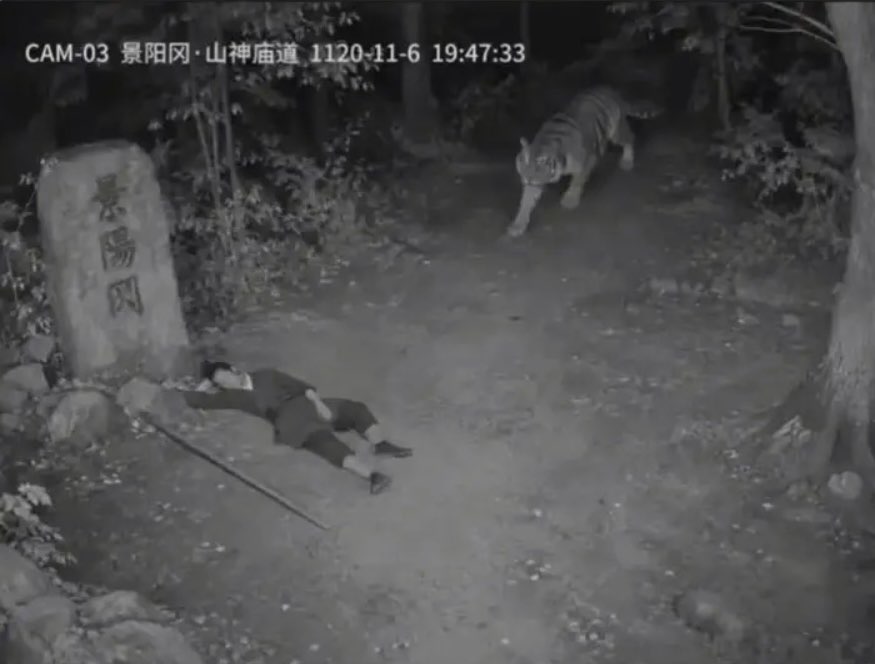
In Water Margin, one of China's Four Great Classical Novels, the episode on Jingyang Ridge is a famous literary scene. Now imagine it presented as CCTV: a fixed camera, a nighttime image, a camera number and a timestamp. A story from another era suddenly appears to have a recording.
The image supplied for this article illustrates that idea. The accompanying video is described as an AI recreation with convincing camera placement, continuous action and realistic scenery. We have reviewed the supplied still, not independently examined the full video. This is fictional creative work, not a historical surveillance recording.
Cover image: A supplied still presented as part of a fictional AI recreation of the Wu Song story. Its surveillance-style appearance is the subject of this discussion, not evidence of a real event.
The interesting question extends beyond how the scene was made. What happens when technology designed to create images meets an industry built around recording reality?
Two Industries Approaching the Same Image from Different Directions
Generative AI and video surveillance can produce images that look similar while serving very different purposes.
For generative AI, a convincing image can be a successful creative outcome. The scene may never have existed, yet it can still communicate a story, support a simulation or help someone explore an idea.
For video surveillance, an image is valuable partly because it is connected to something that happened in front of a camera. Its usefulness depends on place, time, continuity and context, not only visual quality.
The Wu Song example brings these two purposes into the same frame. AI creates the appearance of an observation. Surveillance conventions make that appearance feel like a record.
For AI, Progress Creates a New Responsibility
There is real creative potential in giving an old story a new visual language. A surveillance viewpoint changes the audience's relationship with the scene: instead of watching a staged cinematic moment, we feel as though we have discovered footage.
That possibility could enrich storytelling, education and simulation. In the security field, clearly identified synthetic scenarios could also help teams discuss camera placement, practice incident review or explore situations that would be difficult to stage safely. Their usefulness would still depend on realistic assumptions and appropriate validation.
But the more convincing the output becomes, the more its context matters. A fictional scene shared as entertainment is different from the same scene circulated as evidence. The technical ability to generate a video does not resolve the responsibility to explain what it is.
This suggests a broader measure of progress for the AI industry: not only how effectively a system creates believable content, but how well the surrounding tools and practices help people understand its origin, purpose and limitations.
For Surveillance, Clearer Pictures Are Only Part of the Future
Resolution, low-light performance, storage and analytics remain important. They determine what a system can capture, retain and help an operator notice.
Yet increasingly realistic synthetic video raises another question: how does a recording demonstrate its connection to the system that captured it?
A timestamp or camera label can be reproduced as part of an image. A familiar CCTV viewpoint is a visual style, not proof of origin. Even an authentic recording can be presented without the surrounding footage or described in a misleading way.
One plausible direction for the industry is therefore greater emphasis on trustworthy recording workflows: documenting capture, preserving originals, controlling access and making relevant changes or exports traceable. This would complement image quality rather than replace it.
The value proposition could expand from "we can show you what the camera saw" toward "we can help explain where this recording came from and how it has been handled." That is a technical challenge, but also an operational one.
The Paradox: More Powerful Images, More Demanding Trust
Better synthetic media does not mean every video should be dismissed. It does mean that visual confidence and evidential confidence need to be distinguished.
There are two risks to consider. Fabricated footage may be mistaken for a real event. At the same time, genuine footage may be casually rejected with the claim that "AI could have made it." Both can make it harder to establish what happened.
The answer is neither automatic belief nor universal suspicion. It is a stronger connection between images and their context: source systems, original files, handling records and independent information that can support or challenge the account being presented.
In that sense, the future question is less "Can we spot something strange in the pixels?" and more "What reasons do we have to trust this particular recording?"
AI Can Strengthen Surveillance and Complicate It
AI is not simply an external threat to the surveillance industry. Video analytics can help operators find relevant events, review large volumes of footage and direct attention to situations that need a response.
Generative AI and video analytics nevertheless have different roles. Producing a plausible scene, detecting a possible fall and authenticating a recording are separate tasks. Success at one does not establish capability at the others.
This distinction matters as products adopt broader AI branding. An intelligent alert is an interpretation of a video stream; it is not automatically proof that the stream is authentic or that the interpretation is correct.
For the industry, responsible development means making these boundaries understandable. Customers need to know what a system records, what it infers and what it can actually verify.
Trust Will Need More Than One Technical Solution
Provenance standards, digital signatures, integrity checks and protected recording systems can contribute to stronger trust. They address different questions and depend on how they are implemented and used.
C2PA Content Credentials, for example, support verifiable information about the origin and history of digital content. They do not establish that the depicted event is true or correctly contextualized. Their absence also does not prove that content is fabricated. The C2PA FAQ explains the role of provenance, while the C2PA Explainer distinguishes verification of provenance from factual truth.
Similarly, a file hash can help establish whether a file has changed since a trusted reference was recorded, but cannot turn a fictional scene into a real event. AI-detection results can support investigation without serving as a final verdict.
NIST's overview of synthetic-content transparency examines approaches including provenance, watermarking and detection. For the two industries, the practical implication is that trust requires complementary measures, with their limitations clearly understood.
A Shared Agenda for the Next Stage of Video
If AI and surveillance increasingly operate within the same visual world, they also share a responsibility for keeping that world understandable.
- For AI developers and creators: make the distinction between generated, edited and captured content easier to communicate, and preserve useful provenance where supported.
- For surveillance manufacturers: consider recording integrity, export verification and traceability alongside image quality and analytics, without overstating what any feature proves.
- For platforms and integrators: reduce unnecessary loss of context as footage moves between systems, and explain which authenticity signals are retained or unavailable.
- For system owners: maintain recording and access procedures that preserve useful evidence rather than relying only on the apparent realism of a clip.
These are directions for development, not a claim that a universal verification system already exists. Progress will require cooperation between devices, software, standards and the people who operate them.
From Recording Images to Preserving Confidence
The appeal of an AI-generated Wu Song CCTV scene lies in its impossible premise: a familiar recording technology appears to have witnessed a literary past. Enjoyed as clearly labeled fiction, it demonstrates an imaginative use of new tools.
Its deeper significance is the question it leaves behind. If the visual language of evidence can be generated, what must accompany an image before we treat it as a trustworthy account of reality?
For AI, the opportunity is to expand creativity while helping people recognize how content was made. For surveillance, the opportunity is to strengthen the connection between a recording and the event it is meant to document.
The next stage of video technology may be judged not only by how much we can see or how convincingly we can create, but by how responsibly we can establish what deserves our trust.
At US Vision, these questions inform the discussion around camera selection, recording workflows and AI capabilities. Contact our team to discuss the requirements of your surveillance project, including which recording and verification features need to be confirmed for the selected equipment.
From Industry Questions to Real Deployments
AI event analysis and video authenticity solve different problems. Our guide to adding AI analytics to an existing CCTV system explains how an analysis layer can flag selected events; it does not establish whether a recording is authentic. Preserving original recordings also requires a practical NVR storage and retention plan, controlled access and documented exports.
Key takeaways
- A convincing image is not proof that an event happened; visible timestamps and camera overlays can also be synthesized.
- Generative AI developers should make the origin and limits of synthetic media understandable, while surveillance providers should preserve traceable recordings and exports.
- Provenance records and integrity checks support an evidence workflow, but neither automatically proves that every depicted event is true.
- AI event detection and video authentication are different capabilities. Human review and corroborating evidence remain important.
About the author: This article is published by the US Vision team. Contact us with questions about the information or your project requirements.